
The decline of skilled marketers in the United States and United Kingdom
Skills gaps, collapsing job markets, and what it means for your marketing effectiveness
March 2026
Key sources: Marketing Week Career & Salary Survey (2022–2026), Chartered Institute of Marketing / Hays (2024), World Federation of Advertisers / MediaSense, DMA / WARC, IPA / Peter Field, Gartner CMO Spend Survey, System1 / eatbigfish, Ehrenberg-Bass Institute, Schaffer (2025)
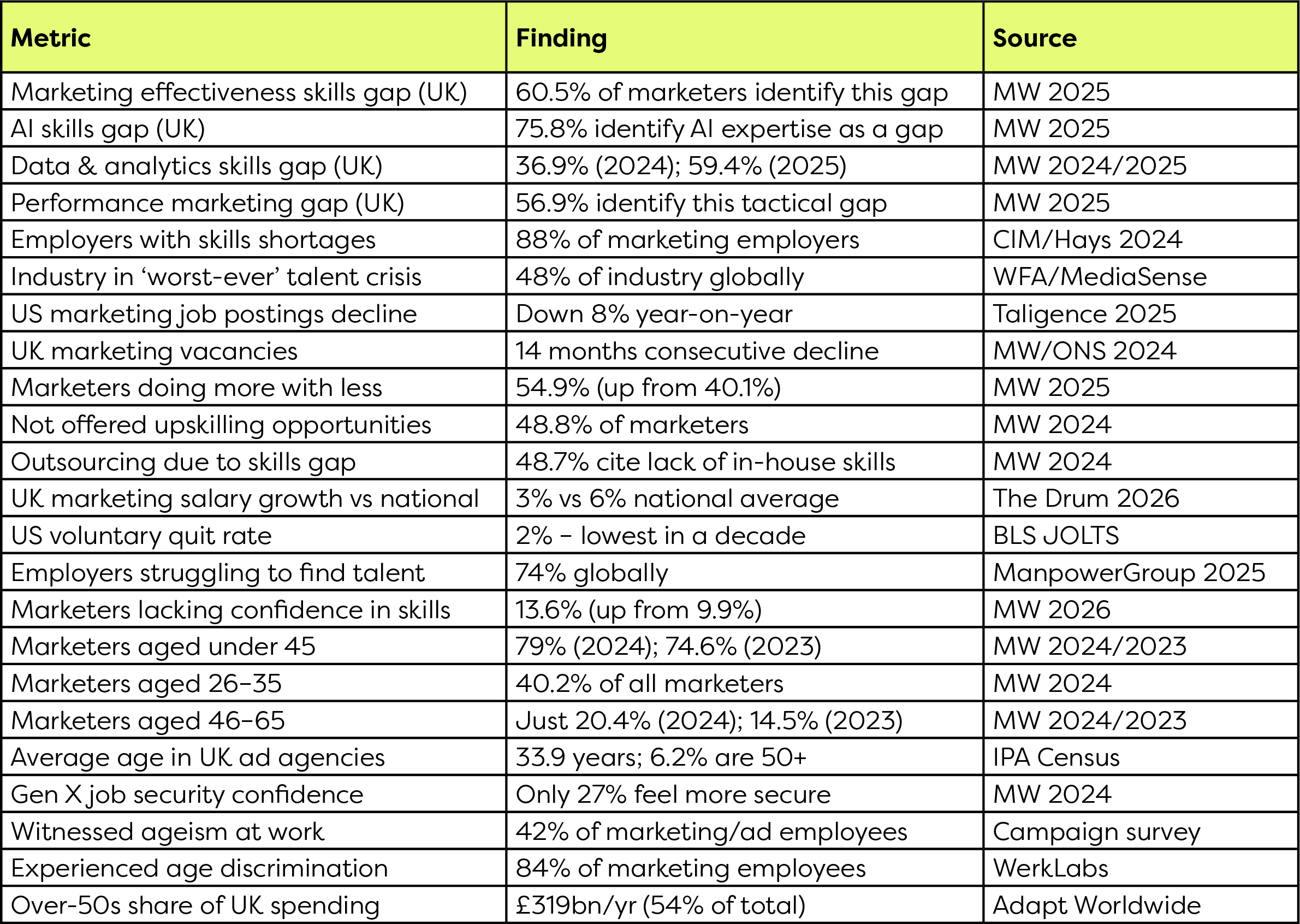
Sixty percent of marketers say their team lacks the skills to measure whether their own work is effective, while 75.8% identify AI expertise as a gap they can’t close. What’s worse, 88% of UK marketing employers couldn’t find the skills they needed last year.
The profession that’s forgetting how to do its job
That is some pretty grim reading.
The marketing profession across the US and UK is critically short of the skills it needs, failing to train the people it has, paying them less than competing sectors, and watching AI quietly eliminate roles from the bottom up. The job market is contracting and the people with the most experience are being pushed out. Meanwhile, the people who remain are being asked to do more with less, with no training to close the gap.
It’s the perfect storm, and the consequences are showing up in the numbers: marketing effectiveness has declined sharply across multiple independent datasets; creatively awarded campaigns are less effective than at any point in the last 24 years of data; the industry is haemorrhaging billions in wasted spend on work that doesn’t work: $189 billion in the US and £13.29 billion in the UK on dull creative alone.
If you’re relying on marketing to drive growth (and if you’re not, you should be asking why), this report is about the people you’re depending on to deliver it.
1. The numbers that matter most
60.5%
of marketers identify a marketing effectiveness skills gap in their business. Among CMOs and marketing directors, the figure rises to 65.9%.
75.8%
identify AI expertise as a major skills gap. For B2B marketers in large organisations, it’s 58.6%.
88%
of UK marketing employers reported skills shortages in the previous year. Nearly nine in ten can’t find what they need.
48.8%
of marketers haven’t been offered the opportunity to upskill. Almost half the workforce has no access to training for the gaps their employers say are critical.
$189bn
in additional spend required in the US alone to compensate for dull creative work. £13.29 billion in the UK.
62%
decline in short-term performance marketing effectiveness over two years. It fell for the third consecutive year.
2. The scale of the skills shortage
2.1 Data and analytics: a gap nobody is closing
From 2022–2024, data and analytics has been the single largest skills gap in UK marketing teams. Marketing Week’s Career & Salary Survey (the most comprehensive longitudinal dataset on UK marketing skills, now in its 27th year) found that 36.9% of over 3,000 brand-side marketers named data and analytics as their primary skills concern in 2024, up from 34.4% in 2023.
Performance marketing ranked second at 19.6%, followed by content and copywriting (18.1%), social media (14.8%), and ecommerce (12.1%).
By 2025, the data and analytics skills gap had widened further to 59.4%.
The persistence of this gap is itself the story. The same deficiency has topped the survey for three years running, and it’s getting worse. Schaffer (2025) found a significant disconnect between the skills employers demand (including SEO, content management, and data analytics) and the capabilities of job candidates, leaving many small and medium-sized enterprises (SMEs) unprepared for digital challenges.
In Marketing Week’s 2025 survey, marketing effectiveness emerged as the dominant skills gap. 60.5% of the 3,500-plus respondents identified a lack of effectiveness knowledge in their business. Staggeringly, among CMOs and marketing directors, the figure rose to 65.9%.
Marketing effectiveness (ensuring that marketing activity drives measurable business impact) is the single most important competency a marketer can have. That three in five marketers report their team isn’t properly equipped for it represents a fundamental failing.
AI expertise: a gap widening faster than it can be filled
The 2025 survey found that 75.8% of respondents identified AI expertise as a major skills gap, overtaking even data and analytics. Over two-fifths (42.8%) reported a lack of martech understanding and for B2B marketers specifically, 51.5% reported an AI skills gap, rising to 58.6% in large organisations.
Gartner found that only 15% of chief executives believe their marketing leaders are currently AI-savvy. The firm predicts that by 2027, a lack of AI literacy will rank among the top three reasons CMOs are replaced at large enterprises.
What employers are saying
The Chartered Institute of Marketing (CIM), working with recruitment firm Hays, surveyed over 400 marketing professionals and employers in 2024. Their findings reinforced the Marketing Week data: 88% of marketing employers reported experiencing skills shortages in the previous year. 52% lacked access to the skills needed for emerging technologies like AI.
These problems aren’t unique to the UK and US. In fact, the World Federation of Advertisers (WFA), working with MediaSense, found that nearly half (48%) of advertisers, agencies, ad tech companies, and media owners believed the industry was facing its worst-ever talent crisis, rising to 54% among agencies, with 77% of respondents reported some or high scarcity of talent, peaking at 85% in the agency and ad tech sectors and 81% in the US.
ManpowerGroup’s annual survey found that 74% of employers worldwide struggle to find the talent they need and 67% believed talent scarcity was a major blocker to growth.
Part two: the collapsing job market
In February 2026 Mark Ritson described what he termed “The Great Stay”: a phenomenon in which marketers are frozen in place, not because they’re satisfied, but because the alternative is worse.
The Taligence 2025 Marketing Jobs Report, based on more than 240,000 US in-house marketing listings, found total postings fell 8% year-on-year. The UK’s Office for National Statistics (ONS) showed marketing and advertising job openings down 8% since 2022. The US voluntary quit rate dropped to 2%, the lowest in a decade.
UK marketing salaries grew just 3% in 2025, against a national average of 6%. The average US marketing salary actually fell by 3%.UK marketing job vacancies declined for 14 consecutive months through December 2024 and permanent job vacancies nationally shrank at the fastest rate in four years. Graduate marketing positions were the worst hit with a 67% reduction in hiring intention.
A K-shaped impact
Ritson identified a K-shaped pattern: senior marketers continue to prosper, but lower-level peers are losing their roles. AI is hollowing out the middle and bottom of the profession while leaving the top relatively intact.
The reporting shows this: Director-level roles held up throughout 2025, graduates were fighting for oxygen, and mid-career professionals found themselves squeezed out.
This is the worst possible shape for a healthy profession. If the industry isn’t developing junior talent today, it won’t have senior talent in five years.
AI is replacing roles, not just tasks
HubSpot reports that 74% of marketing professionals already use AI day-to-day and a Federal Reserve Bank of New York survey from September 2025 found that 12% of service firms had already reduced hiring because of AI with nearly a quarter of those planning to adopt AI expected to hire fewer workers.
Forrester initially predicted US advertising agencies would lose 8% of jobs to automation by 2030, but its most recent report upgraded that estimate to 15%, by the end of 2026 alone. That’s roughly 47,000 positions facing the chop in less than a year. At WPP, headcount dropped from 111,000 to 104,000 in about a year (7,000 people) while 85% of client-facing staff were using the company’s AI platform.
Nobody is investing in training
Marketing Week’s 2024 survey found that 48.8% of respondents hadn’t been offered the opportunity to upskill, a substantial increase from 33.5% in 2023 with only 11.2% of businesses having conducted any form of skills audit.
Schaffer’s (2025) research with US SME marketing managers found that those who did successfully close the digital skills gap did so by embedding continuous learning directly into workflows and prioritising internal development over external hiring. The fact that these practices were identified as noteworthy in a doctoral study speaks to how rare they remain.
Almost two-thirds of brands outsourced work to an agency or third party in the past 12 months. In Marketing Week’s 2024 data, 46.2% of respondents outsourced an element of their marketing, with 48.7% citing a lack of in-house skills as the primary reason and 28.7% citing shrinking team sizes.
Part three: Marketing’s age crisis
Marketing Week’s 2024 survey found that 79% of marketers were aged under 45. The breakdown: 40.2% were aged 26–35, 30% were aged 36–45, and just 20.4% were aged 46–65.
The 2023 survey was starker: nearly three-quarters (74.6%) were aged 26–45, with just 14.5% aged 46–65. For context, 58% of the UK working population falls between 25 and 49 according to the ONS. Marketing is considerably younger than the national workforce norm.
The Advertising Association’s All In Census corroborated these findings and an IPA Agency Census found the average age of employees in UK advertising agencies was 33.9, with only 6.2% of the workforce aged 50 or older, despite that demographic representing 32% of the UK working population.
Older marketers are being pushed out
Recruiters and job-seeking marketers confirmed to Marketing Week that there are currently more senior marketers out of work and looking for jobs than ever before. Former Royal Bank of Scotland Group CMO David Wheldon stated plainly: “The data doesn’t lie. There’s been a problem for several years. Nobody seems to be doing anything about it.”
A Campaign survey found that 42% of advertising, marketing, media, and PR employees had witnessed ageism towards a colleague, and 32% had experienced it themselves. A WerkLabs survey found that 84% of marketing employees reported experiencing age-related discrimination. In Australia, a 2024 study found that over half (51.5%) of premature exits from advertising occurred in the 45–54 age bracket.
Marketing Week’s 2024 survey revealed a stark generational divide. Only 27% of Gen X marketers felt more secure in their jobs than a year ago, compared with over half of their Gen Z colleagues.
The generation with the most experience and the deepest strategic knowledge feels the least secure. The generation with the least experience feels the most comfortable.
People over 50 account for over half of UK household consumer spending, at £319 billion per year. Yet only 5% of ad spend targets adults aged 35–64.
In the US, over-50s make up more than a third of the population but appear in just 15% of media images, according to AARP research. CreativeX assessed over 126,000 ads globally and found that just 4% of the people featured were over 60, and less than 1% were shown in professional or leadership settings.
The industry that prides itself on understanding audiences is failing to understand its own workforce demographics, and its most valuable consumer demographic in the process.
Part four: The decline in marketing effectiveness
Marketing effectiveness has been in sustained decline across multiple independent datasets. The DMA’s Meaningful Marketing Measurement research, based on analysis of over 1,000 DMA Awards entries, found that overall marketing effectiveness declined by 23% in 2021.
The average campaign generated 2.4 effects in 2021, down from 3.1 in 2020 (the highest figure recorded since 2017). By 2023, short-term performance marketing effectiveness had fallen 62% over the preceding two years, declining for the third consecutive year.
A key contributing factor was the continued use of meaningless metrics. Of the 170 measures used by DMA Award entrants, 41% related to campaign delivery measures rather than meaningful business, brand, or response effects. Campaigns that avoided focusing on less meaningful delivery metrics recorded a 67% uplift in business effects on average. Those investing in quality measurement generated 42% more effects.
Peter Field’s 2019 IPA report, The Crisis in Creative Effectiveness, revealed that creatively awarded campaigns were less effective than at any point in 24 years of data analysis. They were no more effective than non-awarded campaigns.
From 1996 to the 2008 recession, creatively awarded campaigns were 12 times as efficient as non-awarded ones, but from 2008 to 2018, that multiplier collapsed to below four times. Field attributed this directly to a shift towards short-term, activation-focused creativity and a growing culture of disposable ideas.
The IPA’s earlier report, Selling Creativity Short (2016), had already warned of a five-year decline in top-performing campaigns. As Field stated: “Despite our warnings, the misuse of creativity has continued to grow and the effectiveness advantage has continued to decline.”
Declining focus on effectiveness
Marketing Week’s Language of Effectiveness study, supported by Kantar, found that the proportion of marketers who believe attention on effectiveness has increased fell from 75% in 2022 to 61.2% in 2023, to just 53.4% in 2024.
The steady decline in the value placed on effectiveness suggests companies are reassessing what they expect from their marketing departments, but not in a way that serves long-term growth.
The budget squeeze
Marketing budgets have been shrinking for years. Gartner’s 2024 CMO Spend Survey found budgets had fallen to 7.7% of overall company revenue, down from 9.1% in 2023 and pre-pandemic averages of 11%.
In the four years preceding the pandemic, average marketing budgets were 11% of revenue. In the four years since, they dropped to an average of 8.2%. By 2025, budgets held at 7.7% for a second consecutive year, though half of CMOs reported budgets of 6% or less.
72% of leaders doubted marketing’s contribution to growth and 64% of CMOs said they lacked the budget to execute their 2024 strategy.
The extraordinary cost of dull
Research from System1, eatbigfish, and Peter Field quantified the waste produced by ineffective creative work. To achieve the same results as non-dull advertising, brands showing extremely dull ads would need to invest an additional $109 billion in the US alone. When moderately and very dull ads are included, the total rises to $189 billion in the US and £13.29 billion in the UK.
Field separately showed that boring rational ads need £9.8 million of extra media spend to achieve the same effects as interesting campaigns that aim for fame.
Professor Karen Nelson-Field’s 2025 study, The Cost of Dull Media, extended this analysis to media environments. $287 billion is being spent globally on media formats that collapse attention while high-attention platforms were found to be up to 11.5 times more effective than very dull and extremely dull formats. Only 17% of digital ads deliver above the two-second attention threshold needed for memories to form.
A 2025 survey by Taboola and Qualtrics of more than 300 US advertisers found that nearly 75% of performance marketers were experiencing diminishing returns on social media ad spend. Most indicated that diminishing returns impacted over 30% of their spend, driven by audience saturation, rising costs, and ad fatigue.Despite social media ad spend projected to reach $239 billion in 2025 and $273 billion in 2026, more spend wasn’t translating into better results.
Part five: the reinforcing cycle
The evidence reveals a self-reinforcing cycle. Skills shortages lead to poorer quality marketing work. Poorer quality work produces declining effectiveness. Declining effectiveness erodes confidence in marketing’s contribution to the business.
Eroded confidence leads to budget cuts, budget cuts lead to smaller teams, fewer training opportunities, and greater reliance on short-term tactics, and short-term tactics further reduce long-term effectiveness.
Meanwhile, the profession pushes out its most experienced practitioners (those with the strategic judgement that AI can’t replicate) in favour of younger, cheaper talent that often lacks the capabilities the industry says it desperately needs.
Part six: The confidence crisis
Marketing Week’s 2026 Career & Salary Survey found that 13.6% of marketers now lack confidence in their skills, up from 9.9% the previous year. Eighty-five percent have experienced imposter syndrome, with half reporting these feelings have intensified over the past year.
Whether driven by a genuine skills deficit or by relentless technological change, this crisis of confidence is shaping how an entire profession views itself, and how it’s viewed by the C-suite.
Gartner’s finding that only 15% of CEOs consider their marketing leaders AI-savvy points to an erosion of trust that extends beyond individual capability. When a function’s leadership lacks credibility with the chief executive, the strategic positioning of marketing as a growth driver is at risk.
Eighty-four percent of brands are now trapped in what Gartner researchers call a “doom loop”: underfunded marketing measurement makes it harder to prove results, leading to tighter budget allocations in subsequent cycles.
Part 7: Frequently Asked Questions
“We have an in-house marketing team. Should we be worried?”
The data suggests you should at least be asking the question. More than sixty percent of marketers say their team lacks effectiveness skills, while 48.8% haven’t even been offered training. If your team is the exception, that’s a genuine competitive advantage. If it isn’t, you’re likely experiencing the consequences in ways that aren’t immediately visible: longer sales cycles, weaker campaign performance, or a marketing budget that doesn’t translate into results.
“Isn’t AI the solution to the skills gap?”
AI is filling some operational gaps. It’s also eliminating the roles where junior marketers used to develop their skills. If the industry isn’t training the next generation, AI becomes a crutch rather than a tool. And the evidence on AI-generated creative work is early but not encouraging; if every company in your sector uses the same tools trained on the same data, the output converges rather than differentiates.
“Our marketing seems fine. How do we know if we have a problem?”
Ask your team three things. Can they measure the business impact of last quarter’s campaigns? Can they articulate why your brand is different from your three closest competitors? Can they explain the balance between short-term activation and long-term brand building in your current budget?
If the answers are vague or inconsistent, the skills gap is there. The DMA data shows that campaigns using quality measurement generate 42% more effects. The gap between knowing and measuring is where the money leaks.
“What does this mean for agencies?”
Agencies are at the sharp end. Talent scarcity peaks at 85% in the agency and ad tech sectors. Forrester predicts 47,000 positions eliminated by the end of 2026. And the K-shaped pattern means the experienced strategists your agency needs are the most expensive to hire and the hardest to retain.
If you’re a client relying on an agency, the question isn’t whether they have the tools. It’s whether they have the people.
“What should we do about it?”
Start with a skills audit. Only 11.2% of businesses have conducted one. Then look at your training investment: if nearly half your team has no access to upskilling, the gap will only widen. And look at your measurement framework: 41% of DMA Award entrants were still measuring delivery metrics rather than business effects.
The companies that will pull ahead are the ones that invest in the capabilities the rest of the market is neglecting.
The skills crisis in marketing isn’t abstract. It’s affecting the quality of the work being produced for you, about you, and on your behalf, right now.
If your marketing team can’t measure effectiveness, you’re spending without knowing what’s working. If they can’t articulate your differentiation, your brand is invisible to 95% of buyers who aren’t in the market today but will be tomorrow. If they’re stretched across too many responsibilities with no training budget, the strategic work that drives long-term growth isn’t getting done.
The reinforcing cycle is clear. The question is whether you’re inside it.
The companies that break out will be the ones that treat marketing capability as a strategic investment rather than an overhead line. They’ll audit the skills they have, close the gaps they find, and bring in the external perspective that internal teams (subject to the same pressures as everyone else) structurally can’t provide.
8. Source Index
Schaffer, N.M. (2025), Strategies for Addressing Digital Marketing Skills Gaps in US Small and Medium-Sized Enterprises, doctoral study, Walden University.
Marketing Week, Career & Salary Survey, 2023.
Marketing Week, Career & Salary Survey, 2024.
Marketing Week, Career & Salary Survey, 2022.
Marketing Week, Career & Salary Survey, 2025.
Marketing Week, Career & Salary Survey, 2025; marketing effectiveness skills gap data.
Marketing Week, "The marketing effectiveness gap," 2025.
Marketing Week, Career & Salary Survey, 2025; CMO and marketing director breakdown.
Gartner, "Only 15% of CEOs consider their marketing leaders AI-savvy," 2024; Gartner CMO predictions, 2027.
Marketing Week, Career & Salary Survey, 2025; tactical skills data.
Chartered Institute of Marketing / Hays, Marketing Skills Survey, 2024.
World Federation of Advertisers / MediaSense, Global Talent Survey, 2022.
World Federation of Advertisers / MediaSense, talent scarcity by sector.
ManpowerGroup, Annual Talent Shortage Survey, 2024.
Mark Ritson, "The Great Stay," Marketing Week, February 2026; Taligence 2025 Marketing Jobs Report; ONS data.
Taligence, 2025 Marketing Jobs Report (240,000+ US in-house marketing listings).
Marketing Week, "UK marketing vacancies declined for 14 consecutive months," 2024; recruitment data.
Mark Ritson, "The Great Stay," Marketing Week, February 2026; K-shaped analysis.
Marketing Week, Career & Salary Survey, 2025; seniority breakdown.
HubSpot, State of Marketing Report, 2025.
Federal Reserve Bank of New York, Survey of Expectations, September 2025.
Marketing Week, Career & Salary Survey, 2024; upskilling data.
Marketing Week, Career & Salary Survey, 2025; “more with less” data.
Marketing Week, Career & Salary Survey, 2024; age demographics. IPA Agency Census; Advertising Association All In Census.
Marketing Week, Career & Salary Survey, 2023; age demographics.
Office for National Statistics, UK working population age breakdown.
Campaign, ageism survey; WerkLabs, age discrimination in marketing survey; Experience Advocacy Taskforce (Australia), 2024.
DMA, Meaningful Marketing Measurement research, 2020–2021.
DMA, Meaningful Marketing Measurement research, 2023; performance marketing effectiveness.
DMA Awards analysis, 170 measures reviewed.
DMA / WARC, marketing effectiveness decline data, 2021.
DMA, Meaningful Marketing Measurement research; overall effectiveness decline.
DMA, measurement quality analysis; business effects uplift data.
Field, P. (2019), The Crisis in Creative Effectiveness, IPA.
Field, P. (2019), creative effectiveness multiplier data, IPA.
Field, P., IPA analysis of creatively awarded campaigns 1996–2018.
Marketing Week / Kantar, Language of Effectiveness study, 2022–2024.
Marketing Week / Kantar, Language of Effectiveness study; year-on-year decline.
Gartner, CMO Spend Survey, 2024.
Gartner, CMO Spend Survey, 2025; budget trends.
Gartner, CMO Spend Survey; C-suite confidence data.
System1 / eatbigfish / Peter Field, The Extraordinary Cost of Dull, 2023.
System1 / eatbigfish / Peter Field, dull creative waste data; US and UK figures.
Field, P., boring rational ads vs. fame campaigns; extra media spend calculation.
Nelson-Field, K. (2025), The Cost of Dull Media, Amplified Intelligence.
Nelson-Field, K. (2025), global media format attention data.
Taboola / Qualtrics, Performance Marketing Survey, 2025 (300+ US advertisers).
Taboola / Qualtrics, social media ad spend projections, 2025–2026.
Marketing Week, Career & Salary Survey, 2026; confidence and imposter syndrome data.
SOBA: PRIVATE LABEL
Soba: Private Label helps B2B brands break free from a sea of sameness. The agency combines human-first creativity with audacious positioning, crafting campaigns and messaging that are mischievous, memorable, and impossible to ignore.
Rejecting conventional agency rules, Soba never works with a client for more than 12 weeks, delivering bold strategy, clever storytelling, and distinctive brand personality.
About the author
Managing Director
Storm is Soba’s Managing Director.
Their copy and campaigns have marketed cybersecurity products to Fortune 500 companies and governments, newspaper advertising packages to SMEs, and conversational AI solutions to the world’s biggest BPOs, among many other things.
They have more than a decade in the trenches, where they’ve managed and built teams and marketed international products across APAC, North America and EMEA.
Storm firmly believes in three things: that B2B marketing doesn’t need to be boring; copywriting should sell; and that even numbers are superior to odd ones.
Contact
Email: Storm@soba.agency
Web: soba.agency